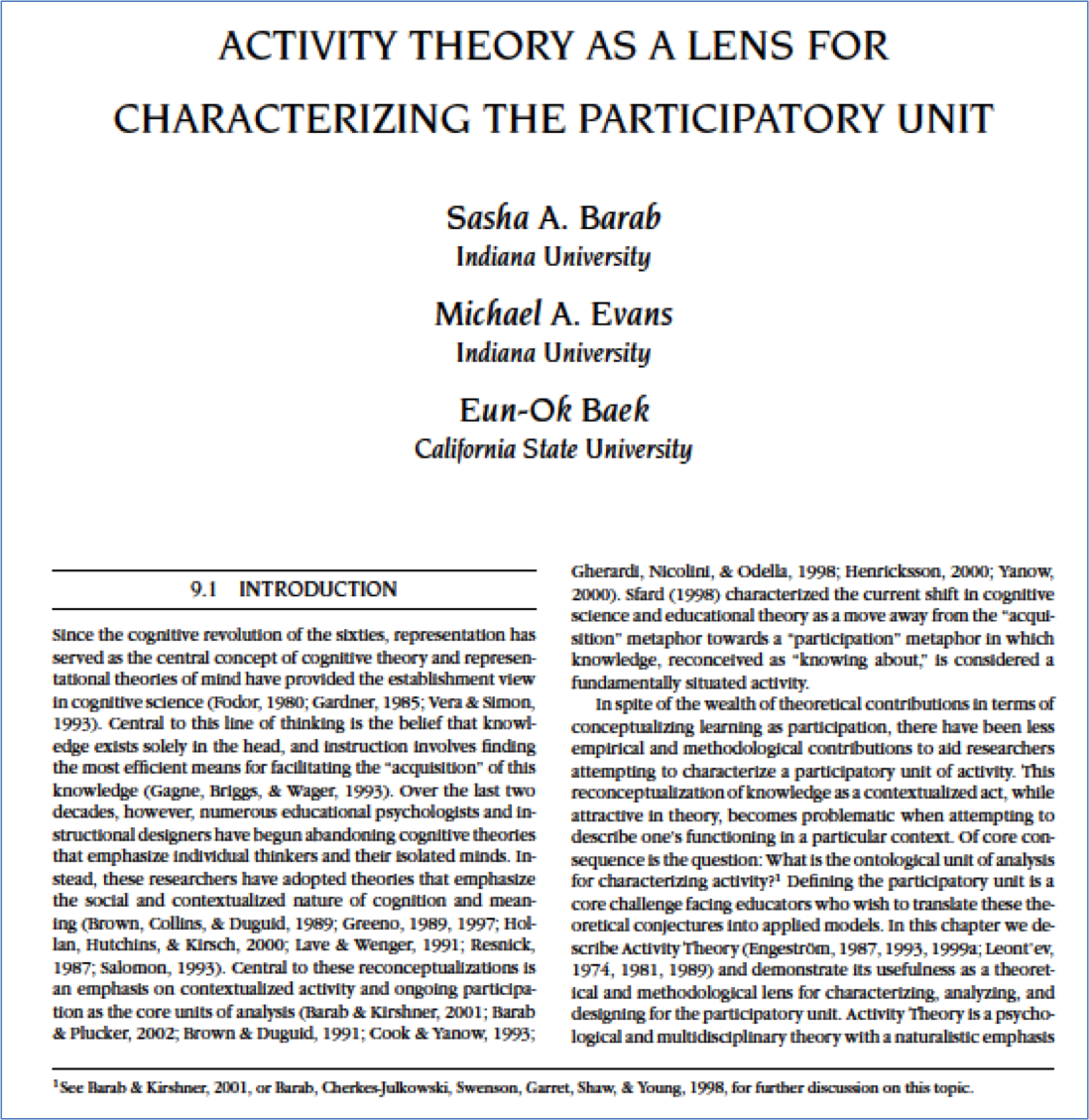
In spite of the wealth of theoretical contributions in terms of conceptualizing learning as participation, there have been less empirical and methodological contributions to aid researchers attempting to characterize a participatory unit of activity. This reconceptualization of knowledge as a contextualized act, while attractive in theory, becomes problematic when attempting to describe one’s functioning in a particular context. Of core consequence is the question: What is the ontological unit of analysis for characterizing activity?1 Defining the participatory unit is a core challenge facing educators who wish to translate these theoretical conjectures into applied models.
In this chapter we describe Activity Theory (Engestrom, 1987, 1993, 1999a; Leont’ev, 1974, 1981, 1989) and demonstrate its usefulness as a theoretical and methodological lens for characterizing, analyzing, and designing for the participatory unit. Activity Theory is a psychological and multidisciplinary theory with a naturalistic emphasis. When accounting for activity, activity theorists are not simply concerned with “doing” as a disembodied action, but are interested in “doing in order to transform something,” with the focus on the contextualized activity of the system as a whole.
From an activity theory perspective, “the ‘minimal meaningful context’ for understanding human actions is the activity system, which includes the actor (subject) or actors (subgroups) whose agency is chosen as the point of view in the analysis and the acted upon (object) as well as the dynamic relations among both” (Barab, 2002, p. 533). It is this system that becomes the unit of analysis and that serves to bind the participatory unit. As such, Activity Theory has much potential as a theoretical and methodological tool for capturing and informing the design of activity. It is in making clear the theoretical assumptions and the applied value of activity theory for research and design that this chapter is targeted
Barab, S. A., Evans, M., & Baek, E. (2003). Activity theory as a lens for charactering the participatory unit. In D. Jonassen (Ed.). International Handbook on Communication Technologies, Vol. 2 (pp. 199-214). Mahwah, NJ: Erlbaum.
About Sasha A. Barab PhD
Sasha Barab is a Professor in the Mary Lou Fulton Teachers College at Arizona State University, where he co-founded and serves as the Executive Director of the Center for Games and Impact.
Dr. Barab is an internationally recognized Learning Scientist who holds the Pinnacle West Chair of Education, and who has researched, designed, and published extensively on the challenges and opportunities of using games for impact.

Leave a Reply