
The Certificate in Games and Impact (handout) provides a solid grounding in theory, design and use of games as tools for affecting change in education, health and social justice, among other fields.
- Learn from and participate in research with renowned Center-affiliated faculty
- Work on real games alongside experts and learn how to design, test and evaluate their impact in the world
- Tailor project work to issues and topics relevant to your field of study
- Access Center for Games & Impact archives, innovation lab, library of games and development resources
Plan of Study (15-18 credits)
- EDT 461/561: Understanding Games for Impact (3 credits)
Principles of applied games design, focusing on analysis of impact games across a range of fields. Students use theories of learning, impact and social entrepreneurship to understand the potential value and implementation challenges of particular games. There is a focus on inputs, outputs, and outcomes, especially unintended consequences of actions in complex social and technical systems. Project work may focus on an in-depth case study of prior games or of current work developed by the center.
Read the Certificate Program Overiew
Want to know more? Fill out our interest form »
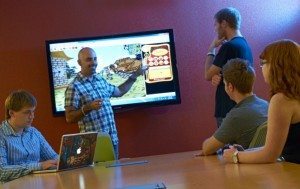
The Certificate is a full plan of work and study, building from an introductory core course through a customized capstone project. Students will be expected to demonstrate expertise in applying games for impact principles to their core areas of interest and solid skills in at least one facet of the process of designing, implementing and evaluating games for impact as part of their capstone work. The Certificate is a significant commitment to a sequenced set of courses across a student’s undergraduate years, rather than a series of courses that may simply be taken in passing. The sequence has been developed to equip students with the skills, research, ambition, and entrepreneurial base to continue to cultivate and curate these ideas beyond the university setting into the public domain—an essential element of our model of impact.
Students will study the ethics of design and consequences, both intended and unintended, how games can lead to social change by improving understanding of complex global systems, transforming conflict and building skills in problem recognition and creative solution design. Certificate students will work on real games, alongside real experts and using expert tools, and learn how to design, test and evaluate their impact in real-‐world environments.
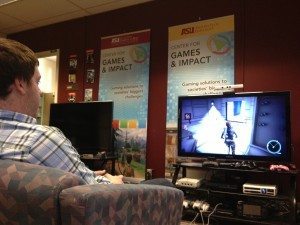 Students may tailor their project work to issues and topics relevant to their fields of study. Business students may develop and evaluate games that apply sustainable principles of the triple bottom line to transform thinking about product development and the supply chain. Health care students will be able to make games that reinforce wellness principles and train practitioners. Social justice advocates will help make and field games to raise awareness and defuse tensions in global conflict areas. Across the courses is a focus on the full lifecycle of using games for impact, with an appreciation of games as a powerful form of intervention for addressing the world’s greatest social, cultural, scientific, and economic problems.
In addition to a tightly focused group of courses, taught by Center-affiliated faculty, the Certificate provides opportunities for students to work directly with activists, entrepreneurs and change agents in their fields of interest on real-‐world projects, not just classroom exercises. Certificate students will have regular access to ASU’s Games for Impact game archives, an innovation lab, library of games, and development resources. They will have special access to events at the Center for Games and Impact.
About Sasha A. Barab PhD
Sasha Barab is a Professor in the Mary Lou Fulton Teachers College at Arizona State University, where he co-founded and serves as the Executive Director of the Center for Games and Impact.
Dr. Barab is an internationally recognized Learning Scientist who holds the Pinnacle West Chair of Education, and who has researched, designed, and published extensively on the challenges and opportunities of using games for impact.
